
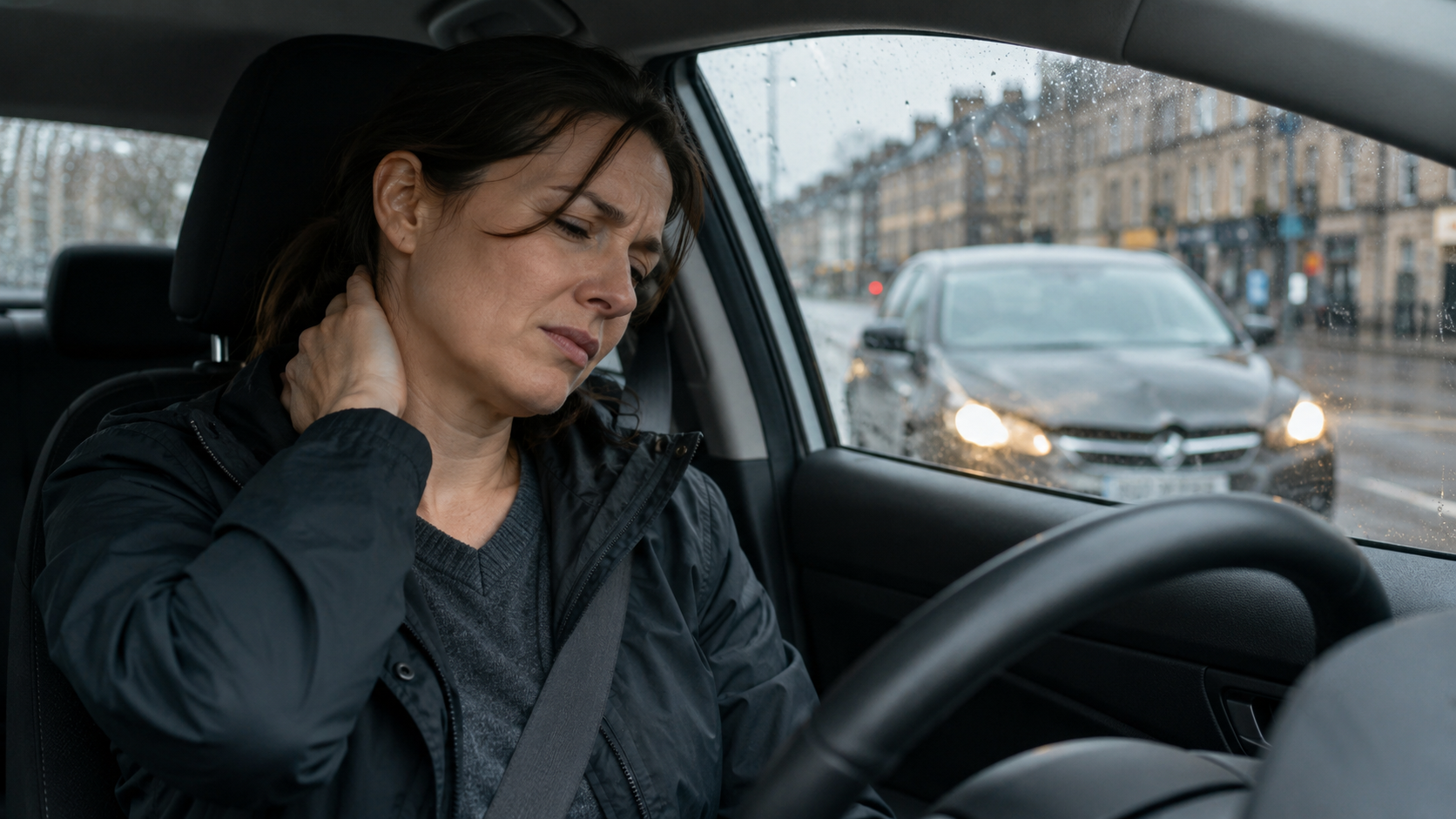
A car jolts forward at traffic lights. A van hits the rear bumper. At first, you feel shaken, maybe annoyed, but not badly hurt. Then the next morning arrives.
Your neck is stiff. Turning your head hurts. A dull headache creeps up from the base of your skull. By lunchtime, sitting at a desk feels impossible. That is often how a whiplash injury Scotland case begins — quietly, painfully, and with far more disruption than many people expect.
Whiplash is sometimes dismissed as “just a sore neck.” That is a mistake. For some people, symptoms settle within a few weeks. For others, pain, headaches, shoulder tension, reduced mobility, poor sleep, and anxiety about driving can last much longer. Scotland Claims notes that whiplash may affect daily life, work capacity, treatment needs, and financial stability, which is why understanding your rights can matter so much.
This guide explains what whiplash is, why it can become serious, how whiplash compensation works, and what steps can strengthen a Scotland whiplash claim after an accident.
What Is Whiplash and Why Does It Happen?
Whiplash is a soft tissue injury caused when the head is forced backwards and forwards suddenly. The movement can strain muscles, tendons, ligaments, and joints in the neck. Rear-end road traffic accidents are a common cause, but whiplash can also happen after workplace accidents, sports collisions, slips, trips, or falls.
The frustrating part? Symptoms are not always immediate.
Someone may walk away from an accident thinking, “I’m fine.” A few hours later, stiffness begins. The next day, the pain is worse. Two days later, driving, working, lifting shopping bags, or sleeping comfortably becomes difficult.
Common symptoms of a whiplash injury Scotland claim may include:
• Neck pain and stiffness
• Headaches starting near the base of the skull
• Shoulder or upper back pain
• Reduced ability to turn the head
• Dizziness or tiredness
• Pins and needles in the arms or hands
• Difficulty concentrating
• Sleep disruption
• Anxiety when travelling in a car again
The injury may sound simple, but the effect can be deeply personal. A delivery driver may be unable to work. A parent may struggle to lift a child. An office worker may find that sitting at a screen for eight hours becomes unbearable.
That is why whiplash should be treated seriously from the start.
Why a Whiplash Injury Scotland Claim Is Not “Making a Fuss”
Many people hesitate before claiming. They worry it sounds dramatic. They do not want to be seen as someone “chasing compensation.” But that view misses the real purpose of a claim.
A whiplash injury Scotland claim is not about exaggeration. It is about recovering losses caused by someone else’s negligence.
If another driver caused an accident and you are left with pain, medical appointments, lost income, travel costs, and weeks of discomfort, why should you carry that burden alone?
One claimant might put it like this: “I didn’t want a fight. I just wanted to get back to normal without losing money because of someone else’s mistake.”
That is a reasonable position.
Compensation exists because injuries have consequences. Some are physical. Some are financial. Some are emotional. A fair claim recognises all of them.
How Whiplash Compensation Works in Scotland
In Scotland, a personal injury claim usually needs to show three things:
• Someone else owed you a duty of care
• That person or organisation breached that duty
• You suffered injury and loss as a result
For a road accident, this might mean proving that another driver failed to stop in time, drove carelessly, ignored traffic conditions, or caused a collision. For a workplace accident, it may involve showing that an employer failed to provide a safe system of work.
Whiplash compensation is usually split into two broad categories.
General Damages
General damages compensate you for pain, suffering, and loss of amenity. “Loss of amenity” means the way the injury affects your enjoyment of normal life.
For example, you may no longer be able to:
• Drive comfortably
• Exercise as usual
• Sleep properly
• Work at a computer without pain
• Pick up children or do household tasks
• Enjoy hobbies such as cycling, running, swimming, or gardening
This part of the claim focuses on the human impact of the injury.
Special Damages
Special damages cover measurable financial losses. These may include:
• Lost earnings
• Medical treatment costs
• Physiotherapy
• Prescription costs
• Travel to appointments
• Care or assistance at home
• Vehicle-related expenses
• Other accident-related costs
Receipts, payslips, medical records, appointment letters, and travel records can all help support this part of the claim.
A Practical Example: The Low-Speed Accident That Wasn’t So Minor
Imagine Sarah, a 38-year-old office manager in Glasgow. She is waiting at a roundabout when another driver hits the back of her car. The damage looks modest. A scratched bumper. A cracked light.
At the scene, she feels embarrassed more than injured.
The next morning, Sarah wakes with neck pain. By the third day, she has headaches and cannot sit comfortably at her laptop. She visits her GP, who records symptoms consistent with whiplash. She later needs physiotherapy and takes several days off work because screen use makes the pain worse.
The insurer may argue, “The vehicle damage was minor.” But that does not automatically mean Sarah’s injury is minor.
A whiplash injury Scotland claim would look at medical evidence, the accident circumstances, symptoms, recovery time, financial losses, and impact on daily life. The important point is not simply how dramatic the accident looked. It is how the accident affected the injured person.
That distinction matters.
Why Medical Evidence Is So Important
Medical evidence is one of the strongest foundations of a whiplash claim.
If you feel pain after an accident, do not simply “wait and see” for weeks. Speak to a GP, NHS 24, a physiotherapist, or another appropriate medical professional. Early medical records help connect the injury to the accident.
They also show that you took the symptoms seriously.
A solicitor will usually need evidence showing:
• When symptoms started
• What symptoms you reported
• What diagnosis or assessment was made
• What treatment was recommended
• How long recovery is expected to take
• Whether there are ongoing limitations
Medical evidence helps prevent a claim from becoming one person’s word against another’s.
It also protects you. If symptoms worsen later, there is already a record showing that the problem began soon after the accident.
The Three-Year Time Limit in Scotland
In many Scottish personal injury cases, there is a three-year limitation period from the date of the accident. Scotland Claims also highlights early action as important because it helps preserve evidence and supports the claim process.
That does not mean waiting is wise.
Memories fade. CCTV can be deleted. Witnesses become harder to contact. Vehicle damage may be repaired. Accident scenes change. Medical notes are strongest when symptoms are reported early and consistently.
The best practical advice is simple: act sooner rather than later.
Not in panic. Not emotionally. Just sensibly.
What Evidence Helps a Scotland Whiplash Claim?
A strong Scotland whiplash claim is built with details. Small pieces of evidence can become very useful later.
Useful Evidence After an Accident
• Photos of the accident scene
• Photos of vehicle damage
• Contact details for witnesses
• Police reference number, if applicable
• Insurance details
• Dashcam footage, if available
• Medical records
• Physiotherapy reports
• Receipts for expenses
• Payslips showing lost income
• Notes about pain and daily limitations
A short diary can also help. It does not need to be complicated.
For example:
“Tuesday: neck pain 7/10, struggled to drive to work.”
“Thursday: headache after two hours at computer.”
“Saturday: could not lift shopping bags without shoulder pain.”
This kind of record makes the impact easier to explain later.
Why You Should Be Careful With Early Settlement Offers
After an accident, an insurer may make a quick offer. At first, that can feel like a relief. Money now. No more stress.
But early offers can be risky.
Why? Because you may not yet know how long your symptoms will last. A person who expects to recover in two weeks may still be in pain three months later. Once a settlement is accepted, it is usually final.
That means if your injury becomes worse, or your recovery takes longer than expected, you may not be able to return and ask for more.
A solicitor can help assess whether an offer is fair based on medical evidence, recovery time, financial loss, and comparable claim values.
The first offer is not always the right offer.
No Win No Fee and Access to Justice
Legal costs are a major reason people avoid making a claim. They imagine bills, risk, complicated paperwork, and stressful conversations with insurers.
No win no fee arrangements are designed to reduce that barrier.
Scotland Claims promotes no win no fee support and states that clients keep 100% of their compensation, with fees recovered from the other side rather than deducted from the settlement.
That can be an important difference for injured people who already feel financially stretched. If someone has missed work, paid for treatment, and dealt with months of pain, losing a percentage of compensation can feel unfair.
When choosing support for a whiplash injury Scotland case, it is worth asking clear questions:
• Will I pay anything upfront?
• What happens if the claim does not succeed?
• Will any percentage be deducted from my compensation?
• Who handles the insurer?
• How will medical evidence be arranged?
• How long might the process take?
Good legal support should make the process clearer, not more confusing.
Whiplash Compensation: What Affects the Amount?
There is no single fixed amount for whiplash compensation because every case is different.
Several factors can influence the value:
• Severity of symptoms
• Length of recovery
• Whether pain affects work
• Whether physiotherapy is needed
• Whether symptoms become long-term
• Impact on driving, sleep, hobbies, and family life
• Lost earnings
• Medical expenses
• Future treatment needs
• Quality of supporting evidence
A mild case that resolves quickly will usually be worth less than a case where symptoms last many months and affect someone’s ability to work.
That sounds obvious, but it is important. The value is not based only on the label “whiplash.” It is based on the real consequences.
Comparing Two Scenarios
Scenario One: Short Recovery
A driver suffers neck stiffness after a rear-end collision. They see a GP, take pain relief, rest for a short period, and recover within four weeks. They lose no income and need little treatment.
This may still be a valid claim, but the compensation is likely to be modest.
Scenario Two: Ongoing Impact
Another person suffers similar initial symptoms but develops persistent neck pain, headaches, poor sleep, and difficulty working at a screen. They need physiotherapy, miss six weeks of work, and avoid driving for months due to anxiety and pain.
This whiplash injury Scotland claim is more complex. It may involve higher compensation because the injury has had a deeper physical, financial, and emotional effect.
The accident might look similar on paper. The consequences are not.
Practical Tips After a Whiplash Injury in Scotland
If you suspect whiplash after an accident, the next few days matter.
First, get medical advice. Do not downplay your symptoms. Be accurate and honest.
Second, report the accident properly. If it was a road collision, exchange details and follow the correct reporting process. If it happened at work, make sure it is recorded in the accident book.
Third, keep documents. Receipts, emails, appointment confirmations, and payslips may all become relevant.
Fourth, avoid posting about the accident or your injury on social media. A simple photo or comment can be misinterpreted later.
Fifth, do not accept a settlement before understanding your recovery position.
And finally, speak to someone who understands Scottish personal injury claims. A general answer from a friend or online forum is not the same as case-specific guidance.
Why Specialist Scottish Support Matters
Scottish personal injury claims have their own legal procedures, time limits, and practical expectations. Working with a team familiar with Scotland can make the process smoother.
A specialist will understand how to present evidence, how insurers assess whiplash cases, when medical reports are needed, and how to challenge an unfair offer.
They also know that a whiplash claim is not just paperwork. It is a person’s life interrupted.
That human side matters.
A good solicitor should listen carefully, explain clearly, and avoid making the claimant feel like a case number. The best support combines legal knowledge with patience, because injury recovery is rarely neat or predictable.
Common Mistakes That Can Weaken a Claim
Some mistakes are easy to avoid once you know them.
Do not delay medical treatment. Do not exaggerate symptoms. Do not ignore treatment advice. Do not throw away receipts. Do not give inconsistent accounts of the accident. Do not assume minor vehicle damage means no claim exists. Do not settle too early.
Most importantly, do not suffer in silence because you think whiplash “doesn’t count.”
It does.
If it affects your health, work, money, or quality of life, it deserves to be taken seriously.
Final Thoughts: What Should You Do Next?
A whiplash injury Scotland claim is not about making trouble. It is about fairness after an accident that was not your fault.
Whiplash can affect work, sleep, driving, family life, confidence, and finances. Some cases settle quickly. Others need careful evidence, medical reports, and firm negotiation. Either way, the strongest position starts with early action.
Get medical advice. Record what happened. Keep evidence. Track your symptoms. Avoid rushing into an offer. Then speak to a Scottish personal injury specialist who can explain whether a claim is realistic and what whiplash compensation may cover.
If you are unsure whether your situation qualifies, the next step is simple: ask. A free claim assessment can help you understand your options without pressure.
Because pain after an accident should not be brushed aside.
And neither should your right to fair compensation.